
.svg)
.png)
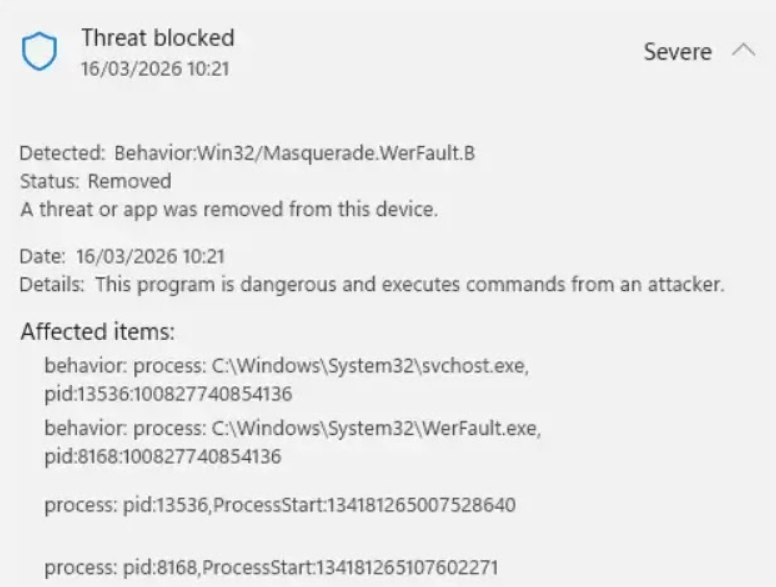
Windows Error Reporting, often seen as WerFault.exe in your process tree, is designed to help diagnose crashes. In modern attacks, it has also become a convenient post-compromise escalation path because it sits close to privileged telemetry, service workflows, and operating system internals.
For CISOs and security managers, the practical lesson is simple. Treat Windows Error Reporting elevation-of-privilege vulnerabilities as predictable ransomware enablers rather than niche local bugs. This is especially true when public proof-of-concept code appears, because it can turn a low-privilege foothold into SYSTEM in minutes and collapse your containment window.
This article traces the evolution from older file system link abuse such as CVE 2019 0863 to recent Windows Error Reporting service flaws such as CVE 2024 26169, observed in activity associated with Black Basta, and the newer ALPC exposed weakness reported as CVE 2026 20817. It then translates the technical detail into detection and patching actions that strengthen KQL free Sentinel triage.
Why Windows Error Reporting keeps reappearing in elevation of privilege chains
Windows Error Reporting touches three areas that are repeatedly abused in privilege escalation:
Privileged services and broker-style behaviour
When a service running as SYSTEM accepts requests from untrusted processes, a single missing permission check can result in a direct privilege boundary breach.
File system and registry side effects
Crash collection creates files and registry keys. If those artefacts are created with weak permissions or follow attacker-controlled links, you get a write primitive that can be weaponised.
Predictable process behaviour
WerFault.exe is common and noisy. Attackers like common processes because defenders normalise them, and alert fatigue works in their favour.
From CVE 2019 0863 to today: what changed and what stayed the same
CVE 2019 0863 and the era of file system link primitives
CVE 2019 0863 is widely associated with public proof-of-concept code that leveraged a timing window and file system link behaviour to make protected system files writable by a non-admin user. Reporting at the time highlighted the use of hard links and race conditions to pivot Windows Error Reporting file operations into privileged targets. You can see a summary of that proof-of-concept behaviour in contemporaneous coverage and vendor analysis. [Bleeping Computer coverage] (https://www.bleepingcomputer.com/news/microsoft/poc-exploits-released-for-two-more-windows-vulnerabilities/) and [Tenable analysis of the published proof of concept] (https://www.tenable.com/blog/sandboxescaper-local-privilege-escalation-bugs-including-four-zero-day-vulnerabilities) provide useful context, while [NVD entry for CVE 2019 0863] (https://nvd.nist.gov/vuln/detail/CVE-2019-0863) captures the official classification and timeline.
What matters for defenders is not the exact exploit code. It is the pattern:
- Trigger Windows Error Reporting activity on demand
- Redirect a write or a permissioned operation using links or path manipulation
- Convert the write primitive into code execution as SYSTEM
Modern Windows has introduced additional mitigations for link traversal, but the broader class of bug remains relevant. Microsoft has continued to discuss mitigations for unsafe junction traversal and related patterns, which is a useful read for understanding how these issues keep resurfacing. [Microsoft MSRC on junction traversal mitigations] (https://msrc.microsoft.com/blog/2025/06/redirectionguard-mitigating-unsafe-junction-traversal-in-windows/)
CVE 2024 26169 and registry-centric escalation used by Black Basta
CVE 2024 26169 is a Windows Error Reporting service elevation of privilege vulnerability that was added to CISA Known Exploited Vulnerabilities in June 2024, indicating evidence of exploitation in the wild. [CISA KEV catalogue entry] (https://www.cisa.gov/known-exploited-vulnerabilities-catalog?search_api_fulltext=CVE-2024-26169) and [NVD entry for CVE 2024 26169] (https://nvd.nist.gov/vuln/detail/CVE-2024-26169)
Public reporting tied exploitation to a weakness where werkernel.sys was described as creating certain registry keys with a null security descriptor, enabling a local user to influence subkeys. The exploit flow discussed publicly then abused Image File Execution Options as a launch mechanism for an attacker-chosen program. [ThreatDown analysis] (https://www.threatdown.com/blog/black-basta-ransomware-exploits-windows-error-reporting-service-vulnerability/)
From a SOC viewpoint, this is a warning sign for two reasons:
- IFEO style debugging features can be turned into a clean-looking persistence and execution path
- The attack can stay largely fileless until the final payload stage, because the registry becomes the control plane
If you want a broader view of how adversaries abuse registry features for fileless tradecraft, Splunk has a useful primer on registry abuse patterns, including IFEO Debugger value misuse. [Splunk registry abuse overview] (https://www.splunk.com/en-us/blog/security/from-registry-with-love-malware-registry-abuses.html)
CVE 2026 20817 and the return of ALPC as an escalation surface
CVE 2026 20817 has been described in public reporting as an elevation of privilege issue in the Windows Error Reporting service that can be exploited via its ALPC interface. Multiple write ups describe attacker controlled messages sent to a Windows Error Reporting service ALPC port and a method often referenced as SvcElevatedLaunch, where insufficient permission checks could lead to SYSTEM level process creation. [Public technical summaries] (https://dbugs.ptsecurity.com/vulnerability/PT-2026-2667) and [example write up] (https://teptez.io/en/blog/cve-2026-20817) are helpful for understanding how defenders should think about telemetry.
The common thread with the older bugs is still there. A privileged broker accepts inputs that should have been permissioned more tightly. The only thing that changes is the plumbing.
When proof of concept code is public, assume it will be integrated into ransomware playbooks quickly. Your response time should be measured in days, not quarters, even if the vulnerability is local only.
Exploitation techniques to brief to executives without losing the plot
You will hear deep technical terms in incident reports. It helps to map them to business relevant risk statements.
ALPC port manipulation
What it is
A local inter process communication mechanism. In this context it becomes dangerous when a SYSTEM service offers an interface that normal users can talk to, and it fails to validate the caller or the request content.
Why leadership should care
This is a fast escalation path after initial access. It can turn a single compromised user account into full host control and credential dumping capability, which then turns into domain spread.
Null security descriptors in werkernel.sys
What it is
A null security descriptor is effectively missing access control metadata. If a privileged component creates keys or objects without strong security, less privileged users may be able to modify what should have been protected configuration.
Why leadership should care
It is a configuration tampering problem created by the platform itself. That means traditional hardening assumptions can fail, and you need compensating monitoring around the resulting artefacts.
IFEO based registry hijacking
What it is
Image File Execution Options is intended for debugging, but it can be abused so that launching a legitimate binary instead launches an attacker chosen debugger program.
Why leadership should care
It is stealthy. It often looks like normal Windows behaviour until you inspect the exact process command line and registry context.
Detection and hunting in enterprise environments
You asked specifically about Sysmon Event ID 10 and Security Event ID 4688. Those are good anchors because they work across EDR vendors and can be forwarded into Microsoft Sentinel.
Baseline what normal WerFault looks like in your estate
Before writing detections, establish the normal:
- Typical parent processes that spawn WerFault.exe in your environment
- Typical command line patterns
- Whether WerFault.exe appears on servers, VDI, and jump hosts, and how frequently
This baseline is what lets you spot the two most important anomalies: suspicious parentage and suspicious frequency.
Use Security Event ID 4688 to catch unusual WerFault.exe spawns
Security Event ID 4688 records process creation when enabled. Focus on:
- WerFault.exe spawned by administrative tools where it is not expected
- WerFault.exe spawned in tight loops
- WerFault.exe spawned shortly after a user context tool such as cmd.exe or PowerShell, which may indicate an exploit chain staging crash triggers
If you only implement one operational rule, implement this: alert when WerFault.exe is spawned from unexpected parents on high value hosts such as domain controllers, certificate authorities, and privileged access workstations.
Use Sysmon Event ID 10 to detect process access patterns that signal escalation tooling
Sysmon Event ID 10 is ProcessAccess, logged when a process opens another process, often used to detect credential theft and injection patterns. Microsoft documents this event and its intent clearly. [Microsoft Sysmon documentation] (https://learn.microsoft.com/en-us/sysinternals/downloads/sysmon)
In the Windows Error Reporting context, look for these higher risk patterns:
- A non standard process accessing WerFault.exe or vice versa in ways that resemble injection or memory inspection
- Processes associated with post compromise activity suddenly interacting with WerFault.exe around the time of a crash trigger
- Access attempts to LSASS nearby in time, suggesting the attacker escalated and moved immediately to credential theft
Microsoft also maintains a structured reference for Sysmon events if you need a quick refresher for your analysts. [Sysmon events reference] (https://learn.microsoft.com/en-us/windows/security/operating-system-security/sysmon/sysmon-events)
Sysmon Event ID 10 can create volume. If you cannot afford full coverage, prioritise domain controllers, identity servers, RMM servers, jump hosts, and server clusters that hold business critical data.
Monitor for IFEO tampering and registry based execution
Even when an elevation of privilege starts in Windows Error Reporting, it often finishes with a persistence or execution trick in the registry.
Practical monitoring steps:
- Alert on creation or modification of IFEO Debugger values for common Windows binaries
- Alert on new registry values that contain unusually long encoded data, which can indicate fileless payload storage
- Correlate registry tampering with process creation of cmd.exe, PowerShell, and service creation events
This is one of the easiest ways to catch the tradecraft described in public reporting around CVE 2024 26169 and the wider ecosystem of fileless techniques. [ThreatDown analysis] (https://www.threatdown.com/blog/black-basta-ransomware-exploits-windows-error-reporting-service-vulnerability/) and [Splunk discussion of IFEO misuse] (https://www.splunk.com/en-us/blog/security/from-registry-with-love-malware-registry-abuses.html)
Actively track proof of concept releases and internalise the timeline
Ransomware groups do not need original research if defenders ignore public exploit releases.
Operationally, you want a small recurring workflow:
- Track new proof of concept publications for Windows local privilege escalation, especially those that mention Windows Error Reporting, ALPC, or IFEO
- Confirm exposure across your supported Windows versions
- Patch, then hunt for exploitation telemetry that predates patching
This is where many SOC teams struggle if they rely on specialist query skills to hunt at speed. If you are pushing towards KQL free Sentinel triage, focus on building guided workflows that ask analysts the right questions, pull the right host telemetry, and standardise the decision points.
If you are considering automation and guided investigation for Microsoft Sentinel, tools that reduce query dependency can help analysts move faster while keeping your detections consistent across tenants and business units. This is also a design goal behind platforms such as [SecQube] (https://www.secqube.com), which wrap Sentinel operations in structured workflows and conversational investigation, though the core best practice remains the same regardless of tooling.
Proactive patching recommendations and governance
Treat these vulnerabilities as post compromise accelerants
Local elevation of privilege is often triaged as lower priority than remote code execution. That is a mistake in ransomware defence.
A realistic risk statement for leadership is:
If an attacker gets a single user session, a Windows Error Reporting elevation of privilege can rapidly create SYSTEM level control, which then enables credential theft, lateral movement, and full domain compromise.
Align patching to CISA KEV and your own asset criticality
For CVE 2024 26169 specifically, CISA KEV inclusion is a strong governance lever. [CISA KEV catalog entry] (https://www.cisa.gov/known-exploited-vulnerabilities-catalog?search_api_fulltext=CVE-2024-26169) and [NVD record] (https://nvd.nist.gov/vuln/detail/CVE-2024-26169)
Your patching policy should explicitly state:
- KEV listed vulnerabilities are patched within a defined SLA on all internet facing and high value internal assets
- Exceptions require documented compensating controls, such as host isolation, removal from admin workflows, and enhanced monitoring
Validate patches by behaviour, not just compliance
For Windows Error Reporting escalation classes, consider validating that:
- WerFault.exe and WER service behaviours align with expectations after patching
- Known exploit primitives no longer work in internal red team validation
- Monitoring rules still fire on simulated malicious patterns, to ensure visibility did not regress
What to tell your SOC team tomorrow morning
If you need a concise action list to brief your SOC leads:
- Prioritise patching for Windows Error Reporting elevation of privilege vulnerabilities, especially those with public proof of concept
- Add focused alerting on unusual WerFault.exe process creation using Security Event ID 4688
- Use Sysmon Event ID 10 selectively on high value hosts to detect suspicious process access patterns around WerFault.exe and credential theft targets
- Monitor IFEO changes and registry based execution patterns as both persistence and escalation follow through
- Build a repeatable workflow for proof of concept tracking, rapid hunting, and post patch validation to reduce dependence on individual KQL expertise
These steps will not eliminate the class of vulnerability, but they will reduce the time attackers can operate after initial access and materially improve your chances of disrupting ransomware operations before encryption and impact
.svg)